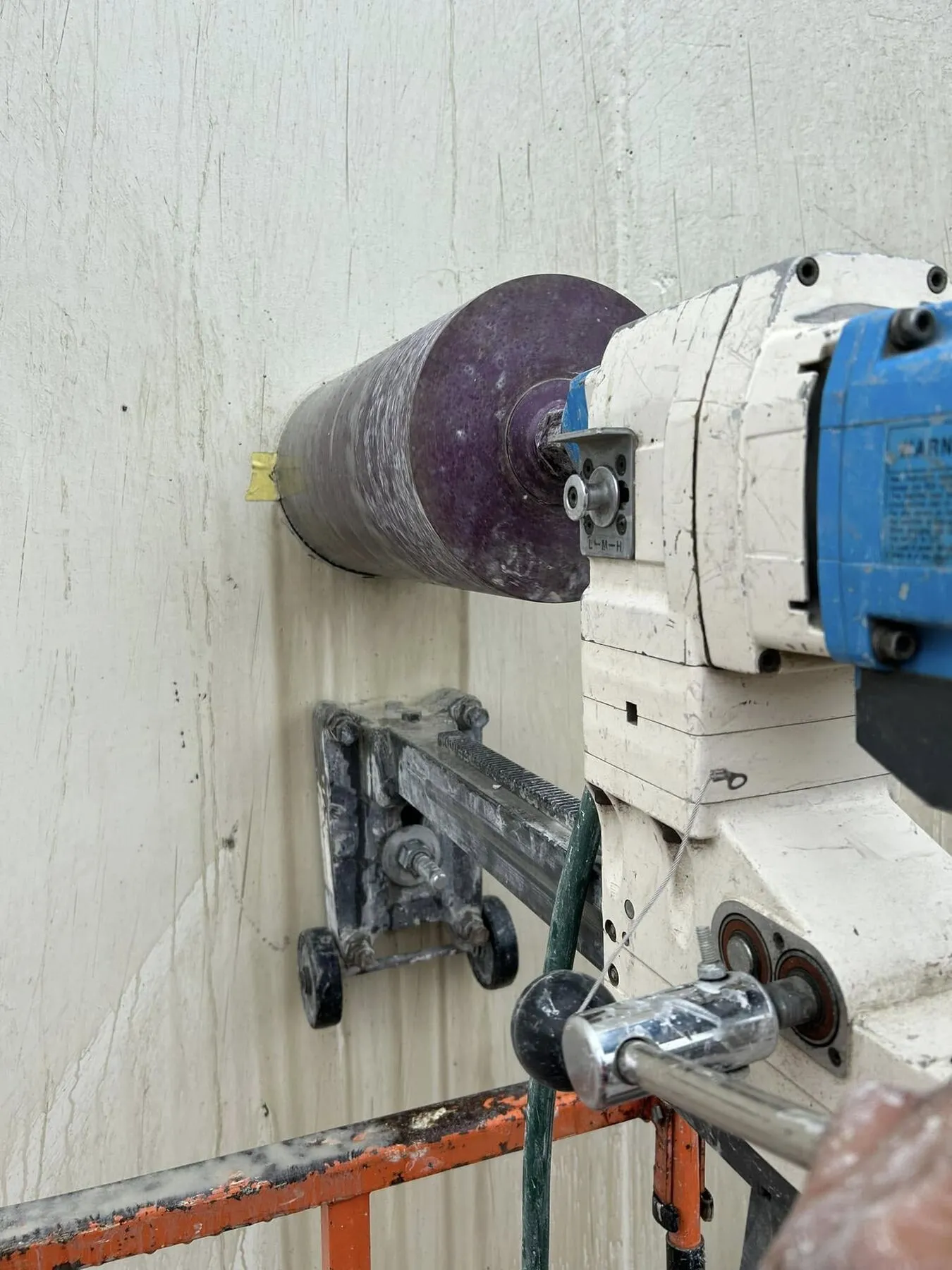
Core drilling
Holes from 20 to 350 mm through reinforced walls, floors, brick and block. Extension bits when it has to go deeper.
Core drilling is a straight route through a concrete structure for something that has to get to the other side: wiring, plumbing, data, ventilation, fire services, earthquake strengthening, structural steel. If you cannot go under it, over it or around it, ring us to go through it.
We drill 20 to 350 mm in diameter, typically to 400 mm deep, and we hold extension bits for when it has to go further. Reinforced concrete, brick, block and masonry, indoors or out, in tight spaces, with the area left clean.
When you need it
These are the situations that put our number into somebody's hand. If yours is not on the list, ring anyway and we will tell you straight whether it is us you want.
- A trade needs a route through a wall or a floor for their services.
- Ducting, a vent or an extraction fan has to go through masonry or double brick.
- A new drainage line has to come into an existing sump or chamber.
- Holes are needed through a retaining wall to relieve the water pressure behind it.
- Structural steel or strengthening work needs a set of holes through existing concrete.
- Access holes are needed under a live floor without disturbing whatever is trading above it.
The numbers
- Hole diameter
- 20 to 350 mm
- Standard depth
- To 400 mm
- Deeper runs
- Extension bits
- Deepest hole so far
- 1350 mm
- Everyday service sizes
- 132, 150 and 172 mm
- Materials
- Reinforced concrete, brick, block, masonry
The 1350 mm hole was a 132 mm bit on an urgent call out in September 2024, phoned through at midday and finished by three.
Have this ready
None of it is compulsory. It is just the difference between one visit and two.
- The hole positions and diameters, and who is signing them off.
- What is behind or under the hole. Services, post tension and underfloor heating are the ones that hurt.
- Power and water at the hole, or tell us in advance if there is none.
- Access for the rig, which is compact but still needs a path from the truck to the wall.
- Whether the cores stay with you or go with us.
How we do it
The kit is named after what it does. The order matters more than the brand on the side of it.
- Mark up and check what is behind the hole first. If nobody on site knows what is in the slab, we scan it before the bit goes in.
- A compact rig that gets into tight spaces, the AGP core drill, fixed down so the hole comes out where it was marked.
- Wet drilling, with the water and slurry caught rather than run across your floor.
- The core pulled out and taken away with us, or left with you, whichever you want.
- The area cleaned before we leave. Tight spaces are not a problem and we always leave the area clean and tidy.
Jobs like this one
Photographed on site, posted at the time, and shown here because the work speaks plainer than we do.
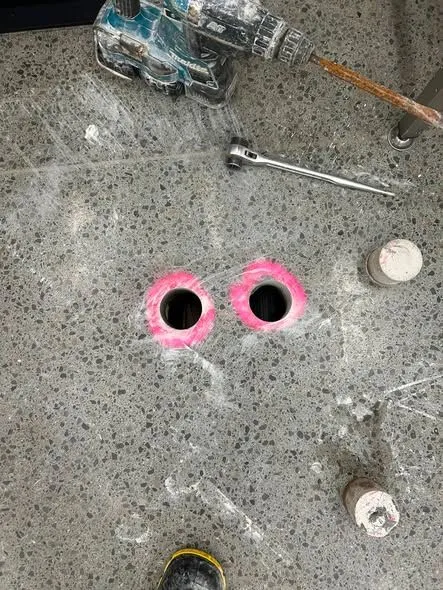
Data duct cores through a supermarket floor
A run of core holes through a supermarket floor to reach the data cable ducts underneath, marked out and drilled one pair at a time.
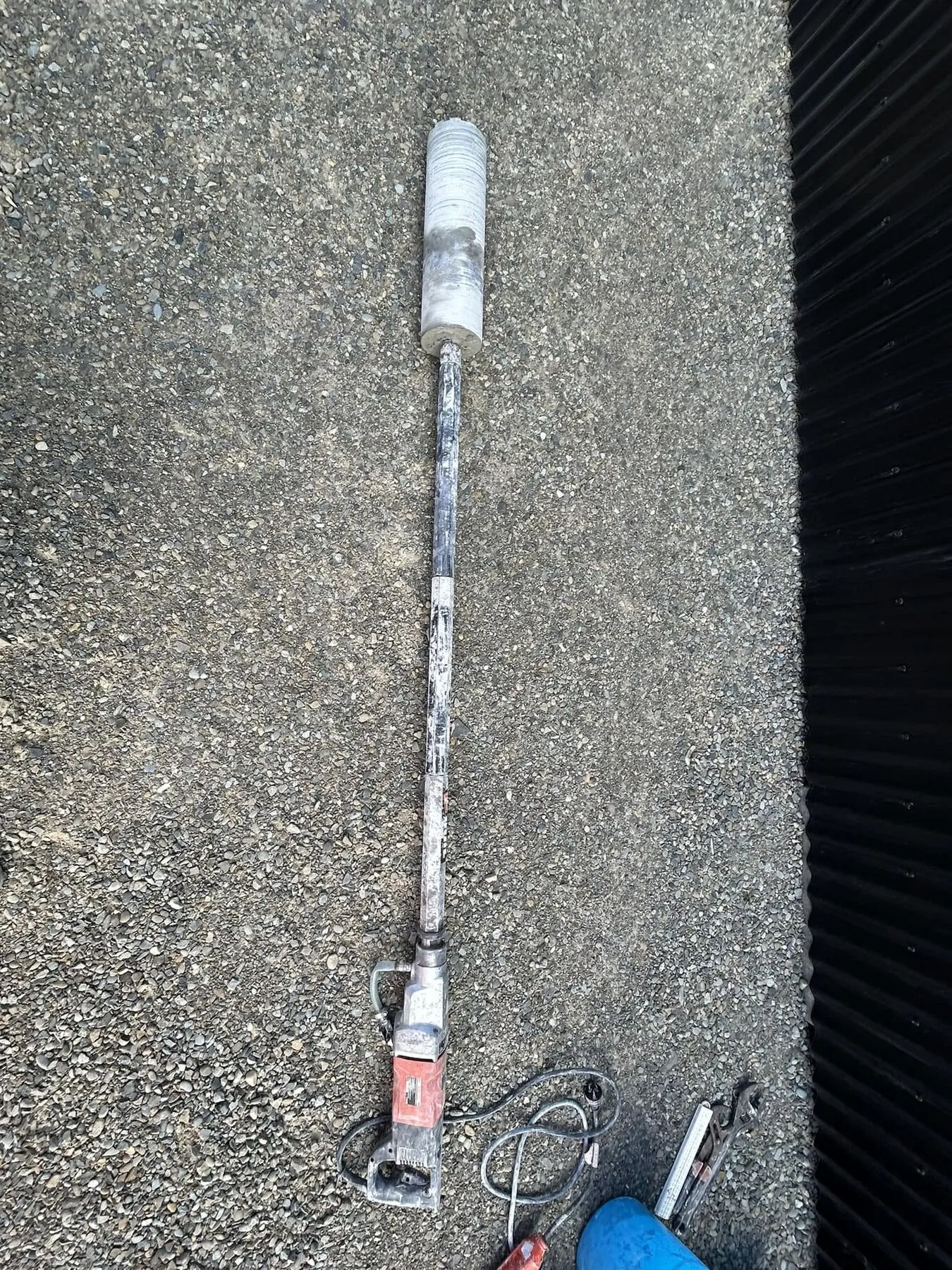
132 mm core to 1.35 m deep, same afternoon
A call for help at midday and a workable solution by 3pm: a 132 mm bit driven to 1350 mm with extension bits, on a site that could not wait.
What we get asked
What size holes can you drill?
20 to 350 mm in diameter, typically to 400 mm deep, with extension bits for deeper runs. The everyday sizes for services are around 132, 150 and 172 mm.
How deep can you core?
400 mm is the standard depth and we hold extension bits well past that. The deepest we have drilled is 1350 mm, with a 132 mm bit, on an urgent call out in September 2024.
Can you drill brick and masonry as well as concrete?
Yes. We core reinforced concrete, brick, block and masonry, including straight through two layers of brick for extraction fans and drainage holes in retaining walls.
Can you drill in a tight space?
Yes. The core rig is compact and needs very little room around it, which is why a lot of our drilling happens in plant rooms, cupboards and hard against existing walls.
Do you drill out existing sumps?
Yes. We drill existing sump and chamber walls to take new drainage pipes, and the compact rig means we work in the hole rather than pulling the sump out.
How much notice do you need?
As little as we can manage. One call in September 2024 came through at midday and we had a workable solution by three that afternoon. Ring and tell us what you have got and we will be straight with you about when we can be there.
Timaru out to the Mackenzie
Timaru and Temuka are the two we get asked for most on this one, but the whole list below is a normal week.
- Timaru Our base
- Temuka 15 min from Timaru
- Geraldine 35 min from Timaru
- Ashburton 75 min from Timaru
- Twizel 150 min from Timaru
We also work across Canterbury, North Otago and the Mackenzie. If the job is worth the drive, we will drive it.
Need core drilling sorted?
Ring the number. Matt answers it, and if he is under a saw he will text you back. Tell us where you are, what you are cutting and how deep, and we will tell you when we can be there.